On this page, you’ll find links to the most recent versions of whatever writing tools I’ve managed to share with the public. With those links, there are detailed instructions for each tool.
These resources will always be free.
If you are another creator and you’d like to share any of these tools with your audience, please credit me and link to this page; I’m doing this for free to try to help other writers and I could use all the support I can possibly get. Thank you.
Directory
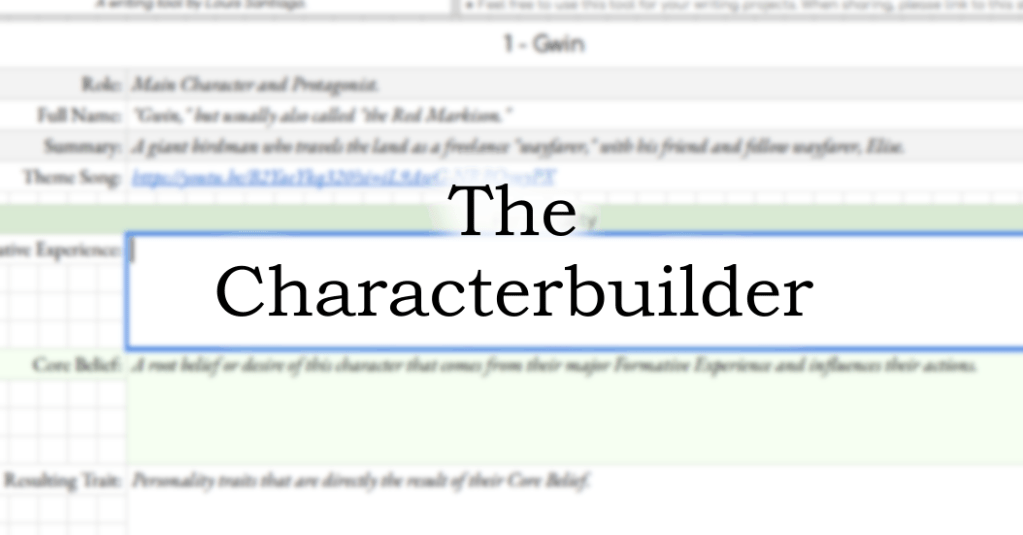
Characterbuilder – A Character Development Tool
Check-Ins – A Technique for Dealing with Writer’s Block
Plotter’s Inventory – A Plot Development Tool
https://docs.google.com/spreadsheets/d/15oSKlTwgncArL0MeGNP0mBxUuDwcuab-cra3itCCWA8/edit?usp=sharing
My personal tool for character design, created out of my desire to have a more well-rounded understanding of my characters before I started writing.
As it’s my personal tool, the Characterbuilder does not include every single detail of a character’s personality (there is, for example, no field that focuses on their occupation, because I usually cover that as part of my worldbuilding doc). Instead, the Characterbuilder focuses on the four aspects of a character that I want to make sure I understand before I write them: personality, voice, appearance, and personal timeline.
The link above leads to a Google Sheet with three tabs: one with “Instructions,” one “Blank Copy” for easy use and printing, and one blank copy “For Villains” that features an extra, antagonist-specific question. However, if you’d rather not click a link on some writer’s website in the digital equivalent of the middle of nowhere, I get it; here’s the entire tool anyway:
[Item #] – [Character’s Most Commonly Used/Current Working Name Here]
Role: Protagonist? Antagonist? Side Character? I tend to use at-a-glance reminders like “Red Herring,” “Enemy-to-Friend,” etc.
Full Name: If naming this character is a work-in-progress, enter a placeholder name for now.
Summary: A simple summary of your character overall. How you might quickly describe them to someone asking you about their role in your story.
Theme Song: Drop a link to the song, if any, that best represents this character.
Personality
- Formative Experience: What is the biggest, most important, personality-defining experience that happened to this character before medias res?
- Core Belief: A root belief or desire of this character that comes from their major Formative Experience and influences their actions.
- Resulting Traits: Personality traits that are directly the result of their Core Belief.
- Emotional Hook: (Essential for main characters.) What does this character want to achieve in the story and how is that desire a good hook for readers? In other words, what relatable desire does this character have that drives the story while keeping readers reading?
- Challenge: (Also essential for main characters.) How are this character’s Core Belief and Resulting Traits challenged in this story? How does attaining/not attaining the goal from their Emotional Hook change their Core Belief? What do they have to sacrifice to get what they want?
- Emotional Aggro: Is this character quick to anger? Conversely, are they often a mediator in arguments, defusing tensions? Are they, like most of us, somewhere in the middle, trying their best to control emotions but failing on occasion? No matter the answer, why are they like this and, when they do get angry, what sets them off?
- Love Manifestation: How does this character express love? Are they hyper-affectionate and supportive of their loved ones in a beautiful, healthy way? Are they similarly healthy but reserved with/embarrassed by displays of affection? Do they often say, over and over, that they love someone but then act to the contrary? Do they never say it and never express it until their dying breath? Would they die for someone they love, or do they swear they would while secretly not loving anyone?
- Grasp on Fear: How does this character react when they’re afraid? Do they hold it together? Are they cool when they encounter a monster or do they run without thinking?
- Failure Resolution: How does this character process their failures? Are they likely to give up when hit by a setback, or do they refuse to accept loses of any kind? Also, is there a particular failure that still haunts them?
- Personal Drive: Does this character work hard to achieve their goals? In this story, what does that drive (or lack thereof) look like? Also, either way, why do that have whatever degree of drive that they have?
- Rounding: Noticeable character details distinct from their Core. Likes, dislikes, bad habits, or other personality quirks that might even be antithetical to their Core.
- Villain’s Flaw: (For villains.) What one, irredeemable flaw stops this villain from being a hero?
Voice
- Vocal Aggro: How aggressive is this character in conversation (for better or for worse)? Are they quick to insult someone? Or maybe quick to toss out a joke? Conversely, are they often reluctant to say anything, worried they won’t be taken seriously (or unwilling to “waste the breath on idiots”)? Whatever the reason, how present is their voice in a scene? Do they often dictate the flow of dialogue or do they only jump in when spoken to?
- Speaking Habit: Unique, identifying speaking habits this character might have. Vocal delivery that easily translates to the page and identifies them in dialogue without tags.
- Origin of Voice: Why does your character speak the way they do? Did they inherit an accent or speech pattern from a specific area in your world? Or maybe from an influential person in their life?
- Spoken Iconography: (Optional.) Is there anything your character commonly says (unique curses, mantras, filler words, etc.) that might distinguish them from other characters outside of your story?
- Dialogue Sample: Take a moment to fill this field with any bit of dialogue that comes naturally for this character. The first thing you think of them saying might say a lot about who they are and how you see them.
Appearance
- Your Mental Picture: A for-you description of your character’s appearance, with all the important elements you can think of. Remember that these elements not might make it into your story (unless you’re using a visual medium), but summarize them anyway.
- Visual Aggro: How visually intense is this character? Are they a literal giant looming over everyone? Do they engage rarely and scowl often? Conversely, do they smile easily? Or do they look worried at all times and only engage with aggression or humor after they calm down? Is this initial impression indicative of / totally antithetical to their full personality?
- Introductory Iconography: The elements of a character’s appearance that you want to stand out when they’re first introduced. The elements of the overall, lasting image that will endure in the reader’s mind for the rest of the story.
- Visual Hook: (Particularly useful for side characters.) Any aspect of this character’s appearance that can be used to easily identify them to the reader (e.g. “a pair of large, circular glasses that look fragile”). Ideally, a visual element you could use in place of this character’s name in narration without confusing the reader (e.g. “The lenses flashed as she looked up from the computer”).
- Silhouette: (Optional.) The physical features of this character that make them iconic, easily memorable to the reader, and immediately recognizable even if you saw them as a silhouette.
Personal Timeline
- Childhood: What was this character’s childhood like? Focus on an overall picture mixed with events that influenced who they are now.
- Adolescence: How did this character handle their teen years as they entered adulthood?
- Adulthood: What kind of adult did this character become?
- Middle Age: As they reached middle age, how did this character change?
- Old Age: Who is this character now, as they get up in age?
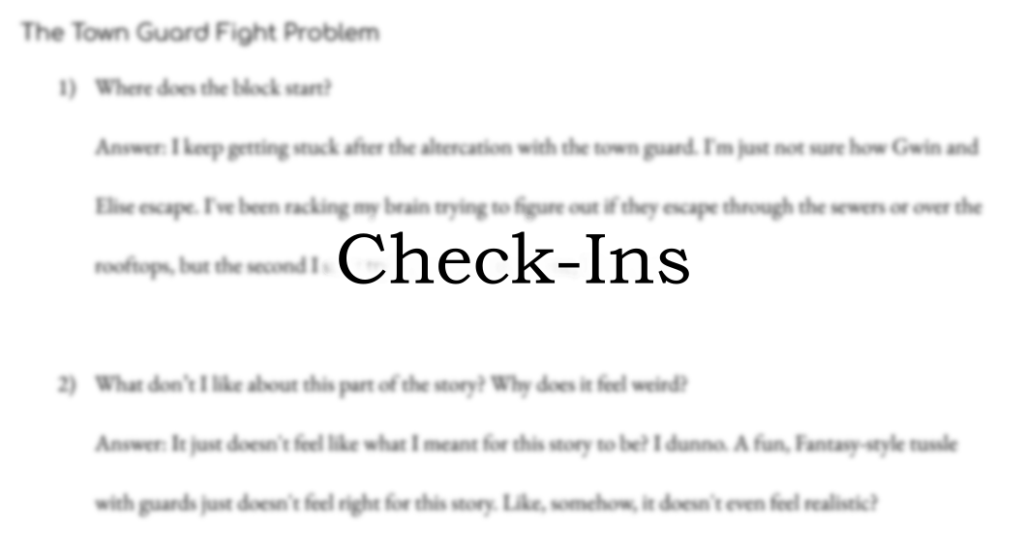
A simple, quick technique for combating writer’s block.
For more details and in-depth instructions, check out the original post about Check-Ins here.
1. Where does the writer’s block start?
Consider the most recent events in your plot and ask yourself if any of them feel weird or ill-fitting for your story.
2. What don’t I like about this part of the story? Why does it feel weird?
Pull back, cast an outsider’s critical eye on the moment that feels weird, and try to pinpoint what makes it feel off. Is it tonally inconsistent with your story? Or perhaps just uninteresting?
3. Is there a good reason to keep this part of the story?
If no, you don’t need to look deeper for something to change; this section of plot or outline is the heart of your writer’s block and you can change it with the following questions.
If yes or maybe, consider the elements around the problem part to find the aspect of it that really doesn’t work. When you find it, that aspect of the scene is the heart of the writer’s block.
4. What are some alternatives to the problematic part of the story?
List all the possible alternatives to the problematic part of the story, calling on every relevant trope you can.
Also, have fun; open your writer’s eye and peer into alternate realities for your story like the omniscient freak you are.
5. Going down the list, what are the pros and cons of each option?
Keying into the themes, goals, and heart of your WIP, consider how each of the options you cooked up works with your story.
Remember: the goal is always to find the alternative that works best for the story you want to write, not the one that’s the coolest (unless you’re going for Rule of Cool, I guess).
6. Which set of pros and cons work best for your story–and provides the most intrigue and fuel–without weighing it down too much?
Again, remember that the goal is to choose an option that suits your story best, not an option that’s going to be the most fun or outwardly impressive.

https://docs.google.com/spreadsheets/d/12cyMhFU6ZLmQRASpKBo3zRmVESzLDsgnoY0lsKW3WlU/edit?usp=sharing
A tool for streamlined plot development. Categories of plot elements in wide, tall columns that allow for varying degrees of obsessive compulsion (including printing out the Inventory so you can physically write on it).
Filling out these categories creates an inventory of A) checklists you can easily reference and B) potential story events you can arrange into a workable plot. This plot can be easily reiterated until you have something you like.
If you’re wary of clicking links, I understand; the tool is extremely easy to replicate and use just by grabbing a sheet of paper or opening a blank file of your choice, splitting it into columns, and following the “Intro” and “Category” instructions below.
General Instructions:
▸”Make a copy” of this Sheet (in the File menu), download it, and/or print it out to use on your own.
▸When printing, set Scale to “Normal (100%).”
▸If your story has Chaotic Plot Elements, make sure you’re using/printing out the “Inventory + CPE’s” sheet.
▸Fill out each category to flesh out your plot.
▸Use “Loose Outline” as a scratch pad to work out a rough, easily-changed plot structure.
★ The ideas presented in the tool are merely suggestion; feel free to alter/reorganize its categories or otherwise change it to better suit your writing process.
★ Feel free to use the tool for your writing projects. When sharing, please link to this sheet.
Intro Instructions:
Heart
You story’s “heart.” To me, this is the personal experience that’s fueling this story for you. Non-essential, but having a heart often helps direct tone, theme, and other story elements.
Theme
The defining message of a story; its greater meaning or central idea, conveyed through character motivations, dialogue, plot events, lore and basically every other part of its design.
▸If your story has a “heart,” that heart can help dictate the story’s theme.
Ex. “When I was young, my family was awful. I want to talk about that experience and convey the idea that you don’t always have to be there for your family if they aren’t there for you.”
Tone
The overall vibe you want to create for your story. Tone stems from heart and theme, but informs narrative style and the overall homogeneity of character design.
Category Instructions:
1 – Genre Tropes
Write down the tropes you do or don’t want to use for your story. I recommend starting here to establish how challenging you want your story to be; using many tropes will make your story more satisfying but predictable while using fewer tropes will make it less satisfying but more unique.
When you have your set of tropes, keep them here so you can easily reference them, picking ones you might want to use and/or reminding yourself of the ones you swore to avoid.
▸Listing tropes and writing out why you do or don’t want to use them might also help you A) round out your intent for this story and B) solidify its theme.
Ex. “3. A horde of monsters appears out of nowhere: Avoid. I don’t want readers to feel that comfortable with my Horror story,” or, “3. A horde of monsters appears out of nowhere: Use! I want to make things pulpy and a little ridiculous, so it’d be hilarious to have a horde show up when it makes absolutely no sense. Maybe characters even call out how ridiculous it is? ‘How the fuck are there zombies on this hot air balloon!? Where are they coming from!?”
2 – Key Character Beats
Important moments for your characters, essential to their growth and the overall story.
Make this field a list of these moments as they arise during plot development. Leave them here as a narrative to-do: a checklist of moments that have to happen at some point. When working on a Loose Outline, refer to/pull from this list to anchor your plot around these moments, establishing an emotional flow for the narrative.
▸I tend to expand these beats into full scene breakdowns, drop them into my Loose Outline, and adjust their wording and positioning as I go.
Ex. “Daega Learns the Truth: He learns he’s been dead for hundreds of years. It’s not really a surprise, but learning the details makes him horrified. Is he a monster? What does it say about him that he always knew, in the back of his mind, that he was? Either way, he’s less shocked than the necromancer thought he would be. ‘What’s next?’ he asks, as if nothing had even happened.”
3 – Seeds
Small moments that set up plot twists or build on promises/tropes you intent to pay off or subvert.
These can be listed as vague moments you intent to develop while writing (“The Matedera’s mask does something weird.”) or as more defined instances of those moments (“The Matedera is not in her room, but all of her masks look at the protagonist as they enter.”). Either way, this field can act as a checklist of moments you want to repeat in your story to build up to one of its key moments, subtly define a character, or tease readers for any other reason.
4 – Items
A more classic inventory; a video game-style list of the equipment your characters have. Not recommended for more casual stories or lighter worldbuilders, but essential for plots where characters have a limited amount of equipment and you want to maintain a level of realism.
▸Also useful as a font for story ideas; listing the items a character has on their person might remind you of their abilities and/or spark ideas for story beats.
▸I recommend an evolving list with explanations:
“Daega
5 Second Skins as of chapter 1. Used to quickly seal wounds. Sheared from the chemically treated husks of the dead. Smell really bad.
-1 (Chapter 5, encounter with monster in town): 4 remaining
-3 (Chapter 12, shares with the team after group fight with necromancer): 1 remaining”
5 – Potential Plot Events
A loose, “blue sky” field for jotting down plot ideas. The equivalent of post-its. Use this column to record everything you want to happen, whether or not it’s too much.
As you advance to the Loose Outline, pull items from this list.
▸I tend to delete these as I go and just commit to whatever direction my plot is heading. However, you might want to leave items here so you can rearrange and try a different direction later.
6 – Loose Outline
A field for your extremely loose, easily changed, proto-outline.
You can comfortably drop in Potential Plot Events–arranging, deleting, and expanding on them as you go–to feel out what you might want your story to be. As you get more settled and find a direction you like, leave your proto-outline here as direction for a tighter, more detailed outline of your own making. Or, if you really like what you’ve developed here, change the heading to “Outline” and start writing.
▸Also consider creating duplicate Sheets (by double clicking on “Inventory w/o CPE’s” on the bottom left and selecting “Duplicate”) or manually duplicating this column (by right clicking the letter at the top, selecting “+ Insert 1 column right,” and Copy & Pasting the column) so you can try other directions for your story.
7 – Chaotic Plot Elements (only on the “Inventory + CPE’s” tab)
A field where you can list the chaotic elements that exist in your story. For example, if your setting is often subject to unpredictable storms, you can jot that down here for easy reference later, when you’re working on your loose outline.
However, I only recommend using this field if your story already has chaotic elements; I don’t recommend creating them in your plot just so you can use this field (instead, use the “Inventory” sheet accessible with the tab in the lower left).
Furthermore, if your story does have chaotic elements, always remember that they’re extremely delicate; a truly random storm that comes when a flipped coin lands on heads can ruin the flow of your narrative. At the same time, a mechanically convenient chaotic element will have no teeth. Of the two, I prefer the random chaotic elements (I love the idea of rolling die to see if something bad will happen), but either way, remember that you’re in control. Putting any degree of randomness in your work might not be the best for you or the art you’re making.
This is currently the end of the list, but I try to share new resources and ideas every month. If you’d like to know when new resources are posted, consider giving me a Follow.
~L. Santiago
 Inktrap